




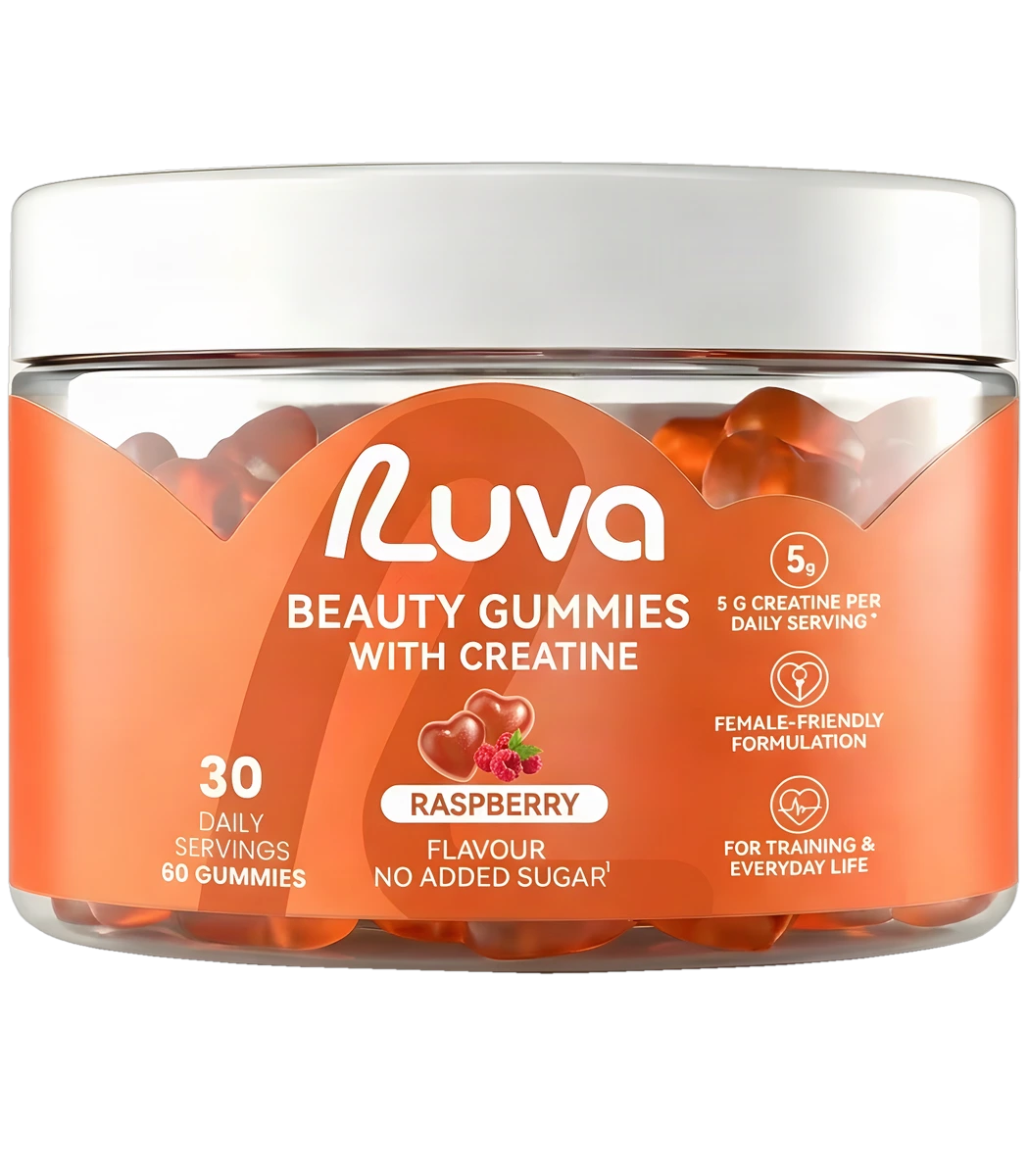
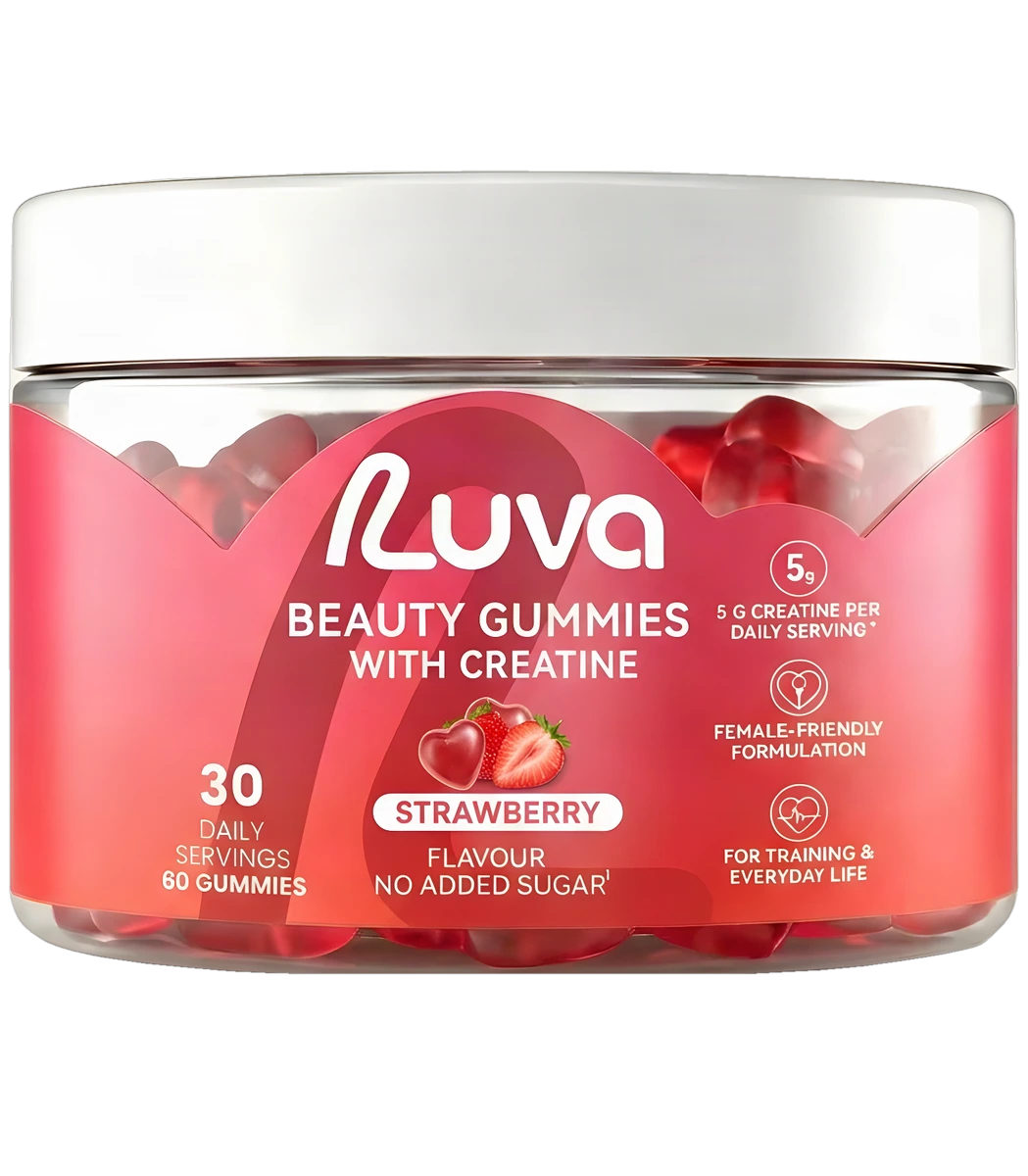


Quick answer: Most research and sports-nutrition guidance uses about 3 to 5 g of creatine monohydrate a day, taken every day. A loading phase of about 20 g a day for 5–7 days fills muscle stores faster, but it is optional: about 3 g a day for ~28 days reached a similar muscle creatine increase in classic research. The EU authorised performance claim is based on 3 g a day. LUVA Creatine Gummies provide 5 g per daily serving (2 gummies).
Not sure how much creatine to take? Use our creatine calculator to estimate a daily dose from your body weight and see how many LUVA gummies that is.
"How much creatine should I take?" is the question behind almost every other creatine FAQ. The honest answer is simpler than social media loading charts suggest: pick a daily amount in the researched range, take it consistently and skip megadoses that mainly upset your stomach.
The researched daily range: 3 to 5 g
The ISSN and related reviews describe creatine monohydrate as effective for high-intensity exercise performance when muscle stores are elevated. Everyday supplemental practice clusters around 3–5 g per day of monohydrate after any optional load.
The EU list of permitted health claims includes creatine increasing physical performance in successive bursts of short-term, high-intensity exercise, with the beneficial effect obtained at 3 g per day for adults performing such exercise. A further authorised claim states that daily creatine can enhance the effect of resistance training on muscle strength in adults over 55, again at 3 g per day, with training at least three times weekly for several weeks at a meaningful intensity.
Those claim conditions are about wording and evidence packages, not a ceiling that makes 5 g "unsafe" for healthy adults. Many studies use 5 g. Always follow your product's directions and medical advice when relevant.
Loading phase: faster, not mandatory
A landmark 1996 study by Hultman and colleagues compared strategies in men:
- 20 g per day for 6 days raised muscle total creatine by about 20%.
- Continuing at 2 g per day maintained the elevation.
- Without maintenance, levels drifted back over about a month.
- 3 g per day for 28 days produced a similar ~20% increase, just more gradually.
So loading is a speed choice. It is not required for long-term saturation. Loading also means more powder or more servings per day for a week, which some people dislike and which can increase gut complaints if large amounts are taken in one go.
Typical patterns
| Approach | Example pattern | Time to higher muscle creatine | Notes |
|---|---|---|---|
| Steady daily | 3–5 g every day | ~3–4 weeks | Simplest; fewer GI issues for many |
| Classic load + maintain | ~20 g/day (split) for 5–7 days, then 3–5 g/day | ~1 week | Faster; split doses across the day |
| Body-mass based (research) | ~0.3 g/kg/day for ~5–7 days, then ~0.03 g/kg/day | Similar to classic load | Used in some protocols; calculate carefully |

Maintenance and rest days
Take creatine every day, including rest days. Stores fall slowly when you stop; they are not emptied overnight. Missing one day is not a crisis. Missing most days means you never fully saturate.
You do not need to "cycle off" creatine for kidney "rest" in healthy people according to ISSN-style reviews, but anyone with kidney disease or medical treatment must follow their doctor's advice. Creatine can raise serum creatinine, a lab marker, without meaning damage: tell your clinician you supplement.

Timing relative to dose
Dose consistency beats stopwatch timing. Morning, post-workout or with a meal are all fine if you remember them. See our timing guide for pre- versus post-workout nuance.
Women and dose
Women were under-represented in early creatine marketing, not in the basic biochemistry. Reviews focused on women's health across the lifespan discuss similar daily gram ranges, with attention to life stages. Pregnancy and breastfeeding remain "ask your doctor" situations because high-quality intervention data are limited. Our creatine for women guide covers myths such as "bulking".
Side effects and dose size
Gastrointestinal distress is more likely with large single servings. A study in soccer players found diarrhoea more frequent after a single 10 g dose than after the same daily total split into two 5 g doses. Steady 3–5 g servings are usually better tolerated. Early weight gain is often water drawn into muscle, not fat.
How LUVA's serving fits
LUVA Creatine Gummies: 2 gummies = 5 g creatine monohydrate per day, plus keratin, biotin and zinc, no added sugar. Raspberry or strawberry, 30 daily servings per tin, halal, delivered within 12 hours across the UAE (free over AED 200).
That 5 g serving sits at the common upper research amount and comfortably covers the 3 g figure used in authorised EU claim conditions. You do not need a separate loading week unless you prefer one; if you did load with powder, return to a normal daily serving afterwards and do not stack extra gummies on top without accounting for total grams.
Food supplement. Not a substitute for a varied, balanced diet and a healthy lifestyle. Do not exceed the recommended daily serving. Keep out of reach of children. If you are pregnant, breastfeeding, under 18, have a medical condition or take medication, consult your doctor before use.
Is more better?
Above saturation, extra creatine is largely excreted. Chronic very high intakes are not supported as more effective for healthy adults chasing the usual performance goals and may worsen stomach comfort. Stick to the label.
The bottom line
Aim for about 3–5 g of creatine monohydrate daily. Loading is optional speed, not a requirement. Take it every day, mind large single boluses if your gut is sensitive and match your product's serving instructions. LUVA's two-gummy serving supplies 5 g for a simple daily habit.
Calculating a personal load (optional)
Some research loads use about 0.3 g per kg body mass per day for 5–7 days (example: 60 kg → ~18 g/day), then a maintenance near 0.03 g/kg or a flat 3–5 g. Split large days into 3–4 servings. If maths feels fussy, the flat 5 g daily approach used by many lifters — and matched by LUVA’s two-gummy serving — is enough for long-term saturation without a formal load.
Teenagers and “more is better” culture
Extra creatine past saturation mostly exits as creatinine in urine. Pushing teens toward adult bodybuilding mega-protocols without clinical oversight is unwise. Under-18s need paediatric or sports-medicine advice before any supplemental creatine. See also is creatine halaal / teens.
Frequently asked questions
Do I need a creatine loading phase?
No. Loading raises muscle creatine faster, but about 3 g a day for roughly four weeks reached a similar increase in classic research. Choose loading only if you want speed and tolerate split higher doses.
Is 5 g of creatine a day too much?
5 g daily is common in research and product practice for healthy adults. The EU performance claim uses 3 g/day as the condition of use. Follow the pack and ask a doctor if you have medical issues.
Should I take creatine on rest days?
Yes. Daily intake keeps stores elevated.
Can I split my dose?
Yes. Splitting can be easier on the stomach if you use larger totals during a load. LUVA's standard serving is two gummies once a day unless your clinician advises otherwise.
How much creatine is in one LUVA gummy?
The daily serving is two gummies for 5 g creatine monohydrate (2.5 g per gummy on average as labelled for the serving).
Discover LUVA Creatine Gummies
5 g creatine per daily serving (2 gummies) · Halal · No added sugar · Delivered within 12 hours across the UAE, free over AED 200
Keep reading
- When to take creatine
- Creatine side effects
- Creatine for women
- LUVA creatine gummies
- Powder vs gummies
Sources
- Hultman E. et al. (1996). Muscle creatine loading in men. J Appl Physiol. pubmed.ncbi.nlm.nih.gov
- Kreider R.B. et al. (2017). ISSN position stand: creatine. JISSN. pmc.ncbi.nlm.nih.gov
- Antonio J. et al. (2021). Common questions and misconceptions about creatine. JISSN. link.springer.com
- Commission Regulation (EU) No 432/2012; Implementing Regulation (EU) 2017/672. eur-lex.europa.eu
- Ostojic S.M., Ahmetovic Z. (2008). Gastrointestinal distress after creatine supplementation. Res Sports Med. pubmed.ncbi.nlm.nih.gov
- Smith-Ryan A.E. et al. (2021). Creatine supplementation in women’s health: a lifespan perspective. Nutrients. www.mdpi.com
This article is general information and does not replace advice from a doctor, dietitian or other qualified professional. Last reviewed: October 2026.